
 中文简体
中文简体

Product Consultation
Your email address will not be published. Required fields are marked *
Content
If you are looking for a direct answer, nitrile gloves are the dominant replacement for latex gloves across most industries today. Whether in hospitals, dental clinics, food processing plants, or automotive workshops, nitrile has overtaken latex as the glove material of choice. This shift began accelerating in the 1990s when latex allergy rates among healthcare workers climbed to alarming levels — some studies found sensitization rates as high as 17% among regularly exposed medical professionals. Since then, manufacturers, regulators, and procurement teams have increasingly favored latex-free alternatives.
That said, nitrile is not the only replacement. Vinyl, neoprene, polyisoprene, and hybrid polymer gloves each occupy specific niches depending on the task, the required sensitivity, chemical resistance needs, and budget. This article walks through all of them in detail — explaining why the shift from latex happened, what the alternatives offer, and how to choose the right one for your specific use case.
Natural rubber latex is derived from the Hevea brasiliensis tree, and it contains proteins that can trigger immune responses in some individuals. Repeated exposure — especially common among nurses, surgeons, and laboratory technicians — causes sensitization over time. Once sensitized, a person may react to even trace amounts of latex protein, with reactions ranging from contact dermatitis to anaphylactic shock.
The occupational health implications became impossible to ignore. The U.S. National Institute for Occupational Safety and Health (NIOSH) issued guidance warnings in the 1990s. By 1997, the FDA required latex-containing medical devices to carry warning labels. Hospitals began phasing out powdered latex gloves, and in 2016, the FDA officially banned powdered latex gloves from the U.S. medical market entirely, citing unacceptable risks including airborne latex protein transmission through the powder.
Beyond allergy concerns, latex has additional drawbacks:
These combined factors — health risk, regulatory pressure, and material limitations — pushed the market firmly toward synthetic alternatives.
Nitrile butadiene rubber (NBR) is a synthetic copolymer made from acrylonitrile and butadiene. It has no natural proteins, which means zero risk of latex-type allergic reactions. This alone made it the front-runner to replace latex gloves in medical and laboratory environments.
Nitrile gloves offer a combination of properties that latex struggles to match in several key areas. They are three to five times more puncture-resistant than latex gloves of comparable thickness. This matters enormously in surgical and clinical settings where needles, scalpels, and sharp instruments are in constant use.
Nitrile also resists a broader range of chemicals. It performs well against oils, fuels, hydraulic fluids, and many solvents — which is why automotive mechanics, chemical plant workers, and tattoo artists also switched to nitrile in large numbers. A nitrile glove rated for chemical resistance will hold its integrity far longer than latex when exposed to petroleum-based compounds.
The global market numbers reflect the dominance of nitrile. The global nitrile gloves market was valued at approximately USD 12.5 billion in 2022 and is projected to grow at a compound annual growth rate (CAGR) of over 8% through 2030. Malaysia alone produces roughly 65% of the world's disposable nitrile gloves, with manufacturers like Top Glove, Hartalega, and Kossan Rubber supplying global demand.
Nitrile is not without trade-offs. Traditional nitrile is thicker and stiffer than latex, which can reduce tactile sensitivity. Surgeons performing delicate procedures sometimes find this problematic, which is why surgical-grade nitrile gloves are engineered to be thinner — often 0.08 to 0.10 mm — to restore dexterity. Standard exam nitrile gloves typically range from 0.10 to 0.15 mm.
Nitrile also does not biodegrade easily. While this aids shelf life, it raises environmental concerns. Some manufacturers now produce biodegradable nitrile gloves using accelerated degradation additives, though these remain a small fraction of the market.
Cost was historically a barrier — nitrile gloves were once significantly more expensive than latex. However, advances in manufacturing and economies of scale have largely closed this gap. In most procurement contexts today, nitrile and latex gloves are comparably priced.
Vinyl gloves are made from polyvinyl chloride (PVC) and are the most affordable option in the disposable gloves market. They are latex-free and suitable for low-risk, short-duration tasks where barrier protection is needed but precision and heavy chemical resistance are not priorities.
Vinyl gloves are commonly used in:
Vinyl gloves are looser fitting than nitrile or latex and offer less tactile sensitivity. They also have a higher rate of microscopic pinholes during manufacturing compared to nitrile. Studies have shown that vinyl gloves can have failure rates up to 26 times higher than nitrile gloves in barrier integrity tests, making them unsuitable for tasks involving bloodborne pathogens or hazardous chemicals.
Despite these limitations, vinyl gloves have a clear role in cost-sensitive, low-hazard environments. For a fast food restaurant changing gloves 20 times per shift per employee, the economics strongly favor vinyl.
There are also growing concerns about the environmental impact of PVC production, which involves chlorine chemistry and can generate toxic byproducts. Some jurisdictions are moving to restrict PVC in consumer products, which may affect vinyl glove availability over the long term.
Polyisoprene is a synthetic version of the isoprene polymer found in natural rubber latex, but it is manufactured without the allergy-causing proteins. The result is a glove that feels and behaves almost identically to latex — the same stretch, the same softness, the same tactile feedback — without the allergy risk.
Polyisoprene gloves are the preferred latex replacement in surgical settings where tactile sensitivity is non-negotiable. Surgeons who spent years training with latex gloves often struggle to adapt to nitrile, and polyisoprene bridges that gap seamlessly. They are used extensively in:
The trade-off is cost. Polyisoprene gloves are typically two to four times more expensive than nitrile surgical gloves. They are also more sensitive to certain chemicals, particularly oils and hydrocarbons, which makes them unsuitable for industrial applications. But for clinical precision work, they remain the gold standard replacement for latex surgical gloves.
Neoprene, also known as polychloroprene, is a synthetic rubber developed by DuPont in the 1930s. As a glove material, it sits in a performance tier above standard nitrile for certain chemical exposures while also offering good flexibility and comfort.
Neoprene gloves are commonly chosen when workers need protection against:
In the medical and pharmaceutical compounding environment, neoprene has become a preferred alternative to latex gloves precisely because it provides latex-like comfort and dexterity while offering broader chemical compatibility. Neoprene is also used in veterinary medicine, where practitioners may need to handle a wide variety of drugs and disinfectants.
Disposable neoprene exam gloves exist, but the material is more commonly found in heavier-duty, reusable industrial glove formats. Cost is again the limiting factor — neoprene is more expensive to produce than nitrile — so it tends to be reserved for tasks where its specific chemical profile justifies the expense.
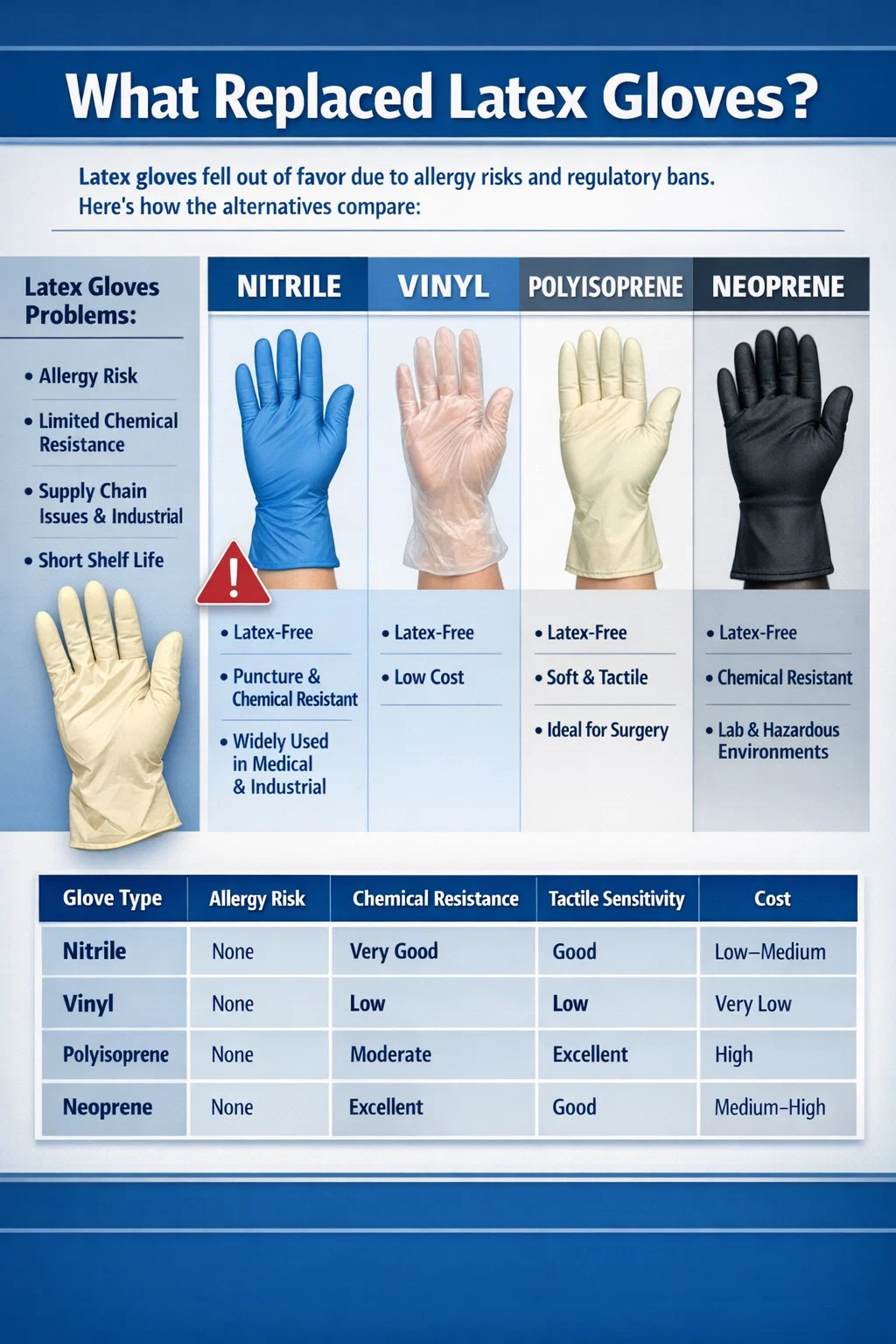
The table below summarizes how the major latex glove replacements compare across the most relevant performance and practical criteria:
| Glove Type | Allergy Risk | Puncture Resistance | Chemical Resistance | Tactile Sensitivity | Relative Cost | Best Use Case |
|---|---|---|---|---|---|---|
| Nitrile | None | Excellent | Very Good | Good | Low–Medium | Medical, industrial, tattoo, automotive |
| Vinyl | None | Low | Low | Low | Very Low | Food service, light cleaning |
| Polyisoprene | None | Good | Moderate | Excellent | High | Surgery, precision dental |
| Neoprene | None | Good | Excellent | Good | Medium–High | Lab, pharma, veterinary |
| Latex (reference) | Yes — proteins | Good | Moderate | Excellent | Low–Medium | Largely replaced in regulated settings |
Hospitals were among the earliest and most aggressive adopters of latex-free policies. After a series of high-profile anaphylaxis cases in the 1990s — including several deaths linked to latex exposure during surgery — healthcare systems across North America and Europe began systematic transitions. The Mayo Clinic, for instance, became a latex-safe facility in 1992, removing latex gloves from all clinical areas and switching to nitrile and polyisoprene alternatives.
Today, most major hospital systems in the U.S., UK, EU, and Australia operate as latex-safe or latex-reduced environments. Nitrile exam gloves are the standard for routine patient care, while polyisoprene and nitrile surgical gloves cover operating rooms. Latex gloves, where still used, are restricted to non-patient-contact applications.
The food industry moved away from latex gloves primarily due to allergen regulations. In many countries, latex proteins are classified as potential food allergens. If latex gloves contact food, traces of protein can transfer — creating undisclosed allergen risk for consumers who are latex-sensitive. Food safety standards in the EU, UK, and the U.S. have driven widespread adoption of vinyl and nitrile in kitchens, food factories, and packaging lines.
In fast food environments, vinyl remains dominant due to low cost. In food manufacturing where hygiene standards are stricter and gloves may be worn for longer periods, nitrile is the standard. Blue-colored nitrile gloves are particularly popular in food processing because their color makes them easy to detect if a glove or fragment contaminates a product during visual inspection.
Automotive mechanics work with motor oils, brake fluids, transmission fluids, and solvents on a daily basis. Latex gloves degrade rapidly when exposed to petroleum-based products — the rubber swells, weakens, and can fail within minutes of contact. Nitrile's resistance to oils and fuels made it the obvious replacement, and the automotive sector adopted it broadly through the 2000s.
Heavy-duty nitrile gloves — typically 6 mil to 8 mil thickness — are now standard in automotive garages. Some applications requiring extended chemical exposure use laminated or multi-layer gloves combining nitrile with additional polymer layers for breakthrough resistance exceeding eight hours.
Tattoo artists were early adopters of nitrile gloves for two practical reasons. First, many tattoo pigments and ink ingredients can degrade latex. Second, latex allergies among clients create potential liability. Nitrile's resistance to inks and dyes, combined with its allergy-free profile, made it the universal standard in professional tattoo studios globally. Black nitrile gloves became the aesthetic norm in the industry — a choice driven partly by practical ink-stain concealment and partly by studio branding.
The COVID-19 pandemic created an unprecedented global demand surge for disposable protective gloves. Between 2020 and 2022, global glove demand approximately doubled. The vast majority of this surge was met with nitrile gloves rather than latex, for several reasons.
First, the manufacturing infrastructure for nitrile was already being expanded aggressively before the pandemic. Second, the medical profession's preference for latex-free gloves meant that pandemic procurement guidelines defaulted to nitrile. Third, Malaysia — which had already built the world's largest nitrile glove manufacturing base — was positioned to scale output rapidly.
Between 2019 and 2021, Top Glove Corporation, the world's largest glove manufacturer, increased annual production capacity from approximately 67 billion gloves to over 100 billion gloves, almost entirely in nitrile. The pandemic essentially locked in nitrile as the global default for disposable protective gloves for years to come, as the massive capital investments made during that period continue to drive supply.
Post-pandemic, glove prices normalized significantly after the supply crunch, but the structural shift toward nitrile and away from latex remained firmly in place. Many first-time glove buyers during the pandemic — including small businesses and consumers — defaulted to nitrile and have continued using it.
The right alternative to latex gloves depends entirely on the context of use. There is no single universal answer beyond the broad dominance of nitrile. Here is a practical framework for making the right choice:
Choose nitrile exam gloves. Look for AQL (Acceptable Quality Level) 1.5 or lower for medical-grade protection. Thickness should be 0.10 mm or above for exam gloves. If workers report discomfort from accelerators used in standard nitrile manufacturing (which can cause Type IV contact dermatitis), look for accelerator-free nitrile formulations — these are increasingly available from major manufacturers.
Choose polyisoprene surgical gloves if tactile sensitivity is the priority. Choose surgical nitrile if puncture resistance and chemical protection are the primary concerns. In practice, many operating rooms stock both and allow surgical teams to select based on the procedure type.
Vinyl for high-frequency glove changes in low-risk food handling. Nitrile for longer wear periods, direct food preparation, or any setting where puncture or chemical resistance matters. Always verify that food service gloves are free of phthalates and comply with food contact material regulations in your jurisdiction.
Match the glove material to the specific chemical or mixture involved. Nitrile covers most petroleum products and many solvents. Neoprene is better for ketones, aldehydes, and certain acids. For strong oxidizing acids like concentrated nitric or sulfuric acid, even neoprene may be insufficient — butyl rubber or laminated multi-layer gloves are required. Always consult the chemical resistance chart specific to the glove model, as resistance ratings vary between manufacturers even for the same base material.
Nitrile disposables work well for cleaning, gardening, and DIY tasks. For dishwashing and prolonged wet work, reusable nitrile or neoprene household gloves are more economical and practical than disposables. If you previously used latex household gloves and are switching due to allergy, reusable nitrile household gloves from brands such as Ansell Marigold or Kimberly-Clark provide comparable durability and grip.
Some manufacturers have developed hybrid gloves combining nitrile with other polymers to achieve a balance of properties. For example, nitrile-vinyl blended gloves offer more stretch than pure vinyl at a lower cost than pure nitrile. These are sold under various brand names and tend to target the cost-sensitive food service market as a step up from vinyl without reaching full nitrile price points.
Several manufacturers — including Kimberly-Clark with their Purple Nitrile Eco line and Microflex with their DuraShield line — have introduced nitrile gloves with biodegradation additives. These gloves are designed to degrade significantly faster in landfill conditions compared to standard nitrile, without compromising in-use performance. This category is growing as sustainability requirements become part of procurement criteria in healthcare and corporate purchasing.
TPE gloves are a relatively new category positioned as an alternative to both vinyl and nitrile in low-risk applications. They offer better elasticity than vinyl, are free from PVC and phthalates, and can be produced at comparable cost to vinyl. TPE gloves are gaining traction in food service and light laboratory work in Europe, where PVC restrictions are pushing buyers away from vinyl.
Research into alternative natural rubber sources has produced guayule — a desert shrub native to the American Southwest and Mexico — as a promising feedstock. Guayule-based latex contains far lower levels of the proteins that cause Type I latex allergies. Companies like Yulex have developed guayule rubber for medical gloves and other applications. While not yet mainstream, guayule-based gloves represent a potential future option that retains the feel and properties of natural rubber without the dominant allergen profile of Hevea latex.
Despite the sweeping shift away from latex gloves, natural rubber latex has not disappeared entirely. It still has some specific advantages that keep it relevant in limited contexts:
However, in regulated healthcare environments in developed markets, latex gloves are effectively obsolete. The question of what replaced latex gloves has a clear answer in those contexts: nitrile did, with polyisoprene covering the precision surgical niche. In broader consumer and industrial markets, the answer is more varied — but the direction of travel is unmistakably away from latex and toward synthetic alternatives that eliminate allergy risk without meaningful compromises in performance.
When Should You Not Use Nitrile Gloves? Key Situations to Know
Why Do Nitrile Gloves Make My Hands Red? Causes & Fixes
Your email address will not be published. Required fields are marked *
You can contact to me using this form.