
 中文简体
中文简体


Product Consultation
Your email address will not be published. Required fields are marked *

Content
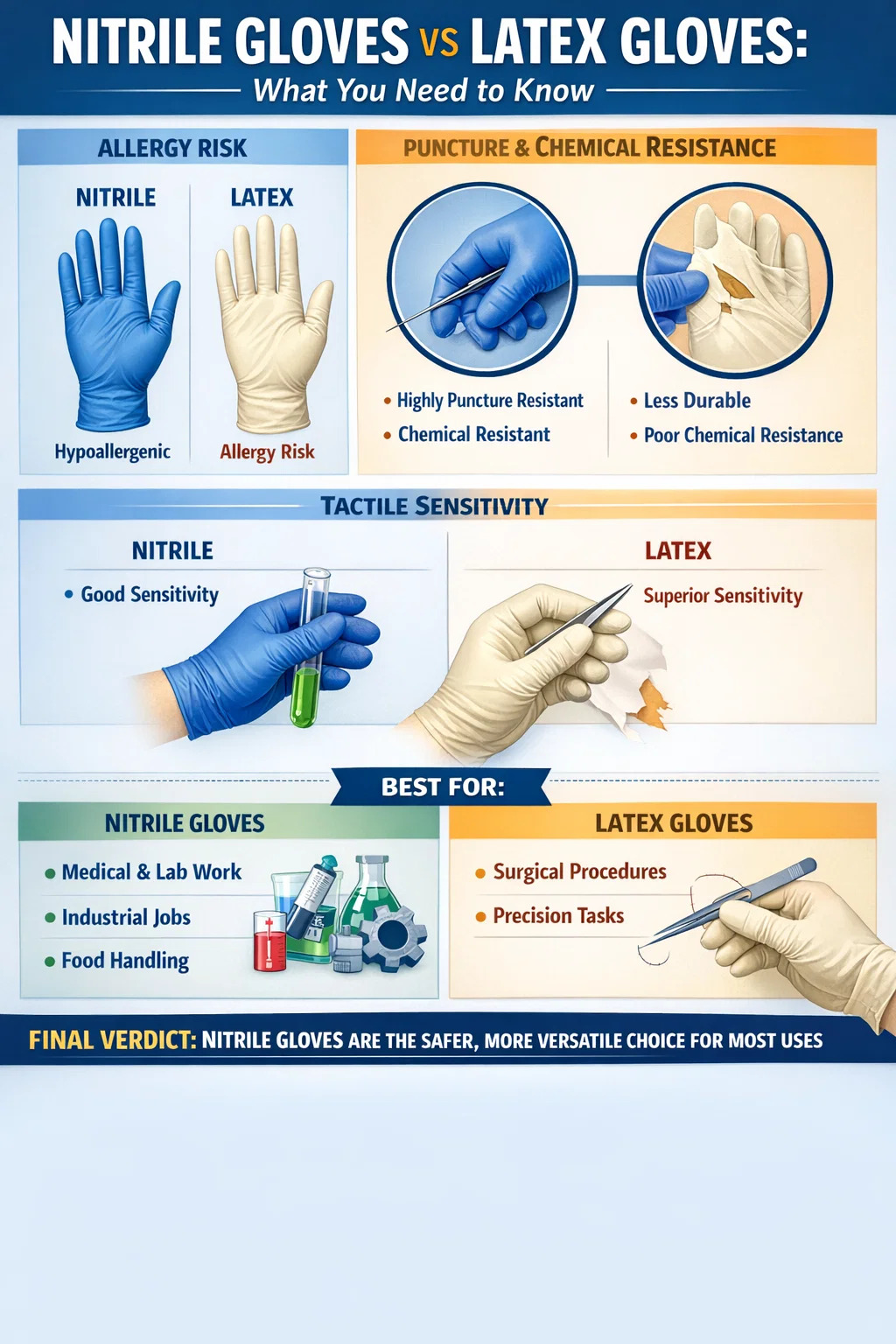
When it comes to choosing between nitrile gloves and latex gloves, nitrile gloves are considered the safer option for the majority of users — particularly in medical, industrial, and food-handling environments. The primary reason is straightforward: latex gloves contain natural rubber proteins that can trigger allergic reactions ranging from mild skin irritation to life-threatening anaphylaxis. Nitrile gloves, made from a synthetic rubber compound, carry no such allergy risk.
That said, "safer" depends on your specific context. Latex gloves still hold meaningful advantages in tactile sensitivity and elasticity, making them preferred in certain surgical and delicate procedural settings. The goal of this article is to break down the differences clearly so you can make an informed decision based on your actual use case — not a one-size-fits-all recommendation.
Latex is derived from the sap of the rubber tree Hevea brasiliensis. It contains over 200 proteins, at least 13 of which have been identified as potential allergens. Latex allergy is not a minor issue — it is a well-documented occupational health hazard.
According to data from the American Academy of Allergy, Asthma and Immunology, latex allergy affects approximately 1–6% of the general population and up to 17% of healthcare workers who are regularly exposed to latex products. For patients with spina bifida or those who have undergone multiple surgeries, the rate can climb as high as 68%.
Latex allergies present in three distinct ways:
Nitrile gloves carry essentially none of these risks. They are free of natural rubber latex proteins, making them the standard recommendation for anyone with a known latex sensitivity or for workplaces aiming to eliminate latex allergen exposure entirely.
Nitrile gloves are manufactured from acrylonitrile-butadiene rubber, a fully synthetic compound. The production process involves no natural proteins, which is precisely what makes them hypoallergenic. Modern manufacturing techniques have dramatically improved the texture, flexibility, and fit of nitrile gloves over the past two decades. Today's nitrile exam gloves are virtually indistinguishable in comfort from latex for most routine tasks.
Latex gloves are made from natural rubber latex, a biodegradable material harvested from rubber trees. The natural origin of latex gives it superior elasticity and a close conforming fit that many surgeons and laboratory technicians still prefer. However, the same natural origin introduces the allergen problem. Powdered latex gloves — once common — have been largely phased out after the FDA banned them in the United States in 2017 specifically due to health risks from aerosolized latex proteins.
One of the most measurable safety differences between nitrile and latex gloves is physical puncture resistance. In occupational and medical settings, a glove that tears or punctures creates an immediate pathway for contamination, chemical exposure, or bloodborne pathogen transmission.
Nitrile gloves are approximately three to five times more puncture-resistant than latex gloves of equivalent thickness. This is a function of the synthetic polymer structure, which resists tearing more effectively under stress. For this reason, nitrile has become the dominant choice in:
Latex gloves, while reasonably durable for light tasks, are more prone to micro-tears under repeated stretching. This becomes a safety concern in high-stress applications where glove integrity must be maintained for an extended period.
Additionally, nitrile gloves maintain their integrity better when exposed to heat or aging. Latex degrades more quickly over time when stored improperly, and expired latex gloves are known to crack or crumble — a hazard that nitrile gloves are much less susceptible to under similar storage conditions.
Chemical resistance is one of the most technically significant differences between these two glove types. Nitrile's synthetic polymer structure gives it exceptional resistance to a broad range of substances that would rapidly degrade latex.
| Chemical / Substance | Nitrile Gloves | Latex Gloves |
|---|---|---|
| Oils and greases | Excellent | Poor |
| Fuels and hydrocarbons | Good | Poor |
| Dilute acids | Good | Fair |
| Dilute alkalis | Good | Good |
| Alcohols | Good | Good |
| Ketones (e.g., acetone) | Fair | Poor |
| Chlorinated solvents | Fair | Poor |
| Biohazardous materials | Excellent | Good |
The superiority of nitrile in oil and hydrocarbon resistance is particularly relevant in automotive repair shops, laboratories, and manufacturing facilities. A latex glove exposed to petroleum-based products can swell, soften, and lose structural integrity within minutes — providing false protection while creating a false sense of security. Nitrile holds up far longer under these conditions, giving workers time to complete tasks or change gloves appropriately.
For laboratories handling a wide range of reagents, nitrile exam gloves rated at 4–6 mil thickness offer a practical balance between dexterity and chemical protection for most routine handling tasks, while thicker 8-mil nitrile gloves are recommended for extended contact with hazardous materials.
It would be misleading to claim that nitrile wins in every category. On the matter of tactile sensitivity and natural fit, many experienced medical professionals still favor latex — and for good reason.
Latex has a higher elongation at break — meaning it can stretch further without tearing — and it conforms more closely to the hand's natural contours due to its superior elasticity. For procedures requiring exceptional fine motor control, such as ophthalmic surgery, intricate suturing, or fine dissection, some surgeons report that latex surgical gloves provide a more natural, second-skin feeling.
However, it is important to note that nitrile glove technology has improved dramatically since the early 2000s. Modern low-modulus nitrile formulations — often labeled as "comfort fit" or "ultra-thin" nitrile — now rival latex in tactile sensitivity for the vast majority of clinical and laboratory tasks. The gap has narrowed considerably, and most institutions have moved to latex-free environments without significant complaints from staff regarding feel or dexterity.
For general-purpose use — cleaning, food preparation, patient care, phlebotomy, specimen handling — nitrile provides entirely sufficient tactile feedback while delivering superior protection and eliminating allergy risk.
In healthcare environments, barrier protection against bloodborne pathogens, bacteria, and viruses is the non-negotiable core function of any examination glove. Both nitrile and latex gloves, when manufactured to regulatory standards, provide effective barrier protection — but the details matter.
The U.S. FDA requires all medical examination gloves to pass the ASTM D6319 standard (for nitrile) and ASTM D3578 standard (for latex), which include tests for acceptable quality levels (AQL) of pinholes, tensile strength, and elongation. An AQL of 1.5 or lower is considered medical grade, meaning no more than 1.5% of gloves in a batch contain defects.
Studies comparing viral penetration rates of nitrile and latex gloves have generally found both materials perform comparably under intact conditions. However, nitrile's superior puncture resistance means that its barrier integrity is maintained more reliably over the course of an extended procedure or during tasks involving mechanical stress. A glove that does not puncture continues to protect; a glove that micro-tears at minute 15 of a 30-minute procedure does not.
From a pathogen protection standpoint, nitrile's durability advantage translates directly into a practical safety advantage — particularly for healthcare workers performing extended patient care or procedures involving sharps.
Choosing the right glove is not purely about which material is chemically superior — it is about matching the glove to the task, the environment, and the individual user. Here is a practical breakdown:
Importantly, the use of latex gloves in any setting where patients, colleagues, or users have not been screened for latex allergy carries inherent risk. For this reason, many hospitals, dental offices, and clinics in North America and Europe have transitioned entirely to latex-free glove protocols.
Both nitrile and latex gloves are available in a range of thicknesses measured in mils (1 mil = 0.001 inch). Thickness directly affects both protection level and dexterity, and selecting the correct thickness is part of safe glove use regardless of material.
| Thickness (mil) | Recommended Use | Available In |
|---|---|---|
| 2–3 mil | Light tasks, food handling, short-duration use | Nitrile, Latex |
| 4–5 mil | Medical exams, laboratory work, general clinical use | Nitrile, Latex |
| 6–8 mil | Chemical handling, tattoo work, extended procedures | Primarily Nitrile |
| 8+ mil | Heavy chemical exposure, industrial protection | Nitrile |
An ill-fitting glove — regardless of material — creates safety hazards of its own. Gloves that are too tight restrict blood flow and reduce grip, while gloves that are too loose bunch at the fingertips and reduce tactile precision. Always select gloves that fit snugly at the palm and fingers without excessive tension or slack. Both nitrile and latex gloves are widely available in sizes XS through XL, and some manufacturers offer extended sizing or ergonomic cuts for broader or narrower hands.
For users concerned about environmental impact, this is an area where latex has a real advantage — at least in terms of biodegradability. Natural rubber latex is a plant-derived material that biodegrades significantly faster than synthetic nitrile under composting or landfill conditions. Nitrile, being a petroleum-derived synthetic polymer, is more resistant to natural breakdown.
However, the full environmental picture is more complicated. Rubber tree cultivation involves land use, pesticide application, and water consumption. Several manufacturers are now producing eco-friendly nitrile gloves made with accelerator-free formulations or bio-based nitrile compounds designed to break down faster in landfill environments — a development that may eventually close the sustainability gap.
For now, if biodegradability is a key concern and latex allergy is not a factor in your environment, latex gloves represent the more environmentally responsible disposable option. For everyone else, the safety benefits of nitrile outweigh the biodegradability advantage of latex in practical terms.
Historically, nitrile gloves cost more per unit than latex gloves. However, the price gap has narrowed considerably over the past decade due to increased manufacturing capacity, particularly from Southeast Asia. As of recent market data, nitrile exam gloves typically cost 10–30% more per box than comparable latex gloves, depending on brand, thickness, and quantity.
When factoring in total cost of safety, nitrile becomes even more competitive. The liability and healthcare costs associated with a latex allergy reaction — particularly a Type I anaphylactic event in a clinical setting — far exceed any per-glove price difference. Several lawsuits involving healthcare workers and patients who suffered severe latex allergic reactions have resulted in significant settlements, driving institutional risk managers to mandate latex-free environments regardless of cost.
For individual consumers buying gloves for household use, the cost difference translates to a few dollars per box — a negligible amount given the protective benefits of nitrile, especially if you are unsure of your own or household members' latex sensitivity status.
Not entirely. While nitrile gloves eliminate natural rubber latex proteins, some individuals develop sensitivity to the chemical accelerators used in the vulcanization process of both nitrile and latex gloves — compounds such as thiurams, carbamates, and mercaptobenzothiazole. These can cause Type IV delayed allergic contact dermatitis. For highly sensitive individuals, accelerator-free nitrile gloves are available and specifically recommended.
Thickness increases chemical and puncture resistance, but it also reduces tactile sensitivity and can increase hand fatigue. A very thick glove worn during a procedure requiring fine motor control may actually increase error risk. Match glove thickness to the actual hazard level of the task.
Double-gloving does provide an additional barrier and is recommended in certain high-risk surgical and chemotherapy preparation settings. However, it does not simply double protection against chemical permeation — for chemical resistance, glove material and thickness remain the determining factors. Double-gloving with two inadequate gloves does not substitute for using a single appropriately rated glove.
Gloves are a protective barrier, not a substitute for hand hygiene. Hands should be washed before donning gloves and after removing them. Gloves can develop micro-perforations that are not visible to the naked eye, and contamination can occur during glove removal if proper technique is not followed.
When you weigh allergy risk, puncture resistance, chemical resistance, durability, and the direction of institutional health policy globally, nitrile gloves come out ahead as the safer, more practical choice for the overwhelming majority of use cases. The elimination of latex allergy risk alone is compelling enough for most healthcare facilities, food service operations, and industrial workplaces to standardize on nitrile.
Latex gloves retain legitimate advantages in surgical tactile sensitivity and biodegradability, and remain a valid choice in environments where latex allergy has been confirmed as a non-issue and fine motor precision is the top priority. But for general use — medical exams, food prep, cleaning, laboratory work, automotive maintenance — nitrile delivers superior protection with no allergy risk and better resistance to the physical and chemical hazards most users actually encounter.
If you are stocking gloves for a workplace, a clinic, or your own home and you are not certain about latex sensitivity in your environment, defaulting to nitrile is the straightforward, evidence-backed decision. The small price premium is well justified by the broader safety margin and the peace of mind that comes from knowing you have eliminated one significant and entirely preventable risk.
Why Do Nitrile Gloves Make My Hands Red? Causes & Fixes
What Should You Not Use Nitrile Gloves For? Key Limitations
Your email address will not be published. Required fields are marked *
You can contact to me using this form.